
How Semantic Arts enabled omics R&D teams to connect their legacy and current gene data across public databases, release by release.
| Client | Biopharmaceutical leader, 30K+ employees, US$35B+ total revenue |
| Domain | Genomics and proteomics drug discovery |
| What we did | Ontology design and knowledge graph build |
| Sources | RefSeq, Ensembl, GENCODE, UniProt, QIAGEN OmicSoft, and internal data |
| Standards | RDF, OWL, SHACL, SPARQL, federated SPARQL |
| Status | In production; ongoing |
The challenge
Genomics data identifies genes using public reference databases such as RefSeq, Ensembl, and GENCODE, with new releases every few months. Gene records get renamed, merged by synonym linkage, split, and retired between releases. Even a gene symbol that scientists use every day is not a stable identifier: the same symbol can point to different genes over time, and one gene can carry several symbols throughout the multi-decade lifespan of drug development and patient monitoring.
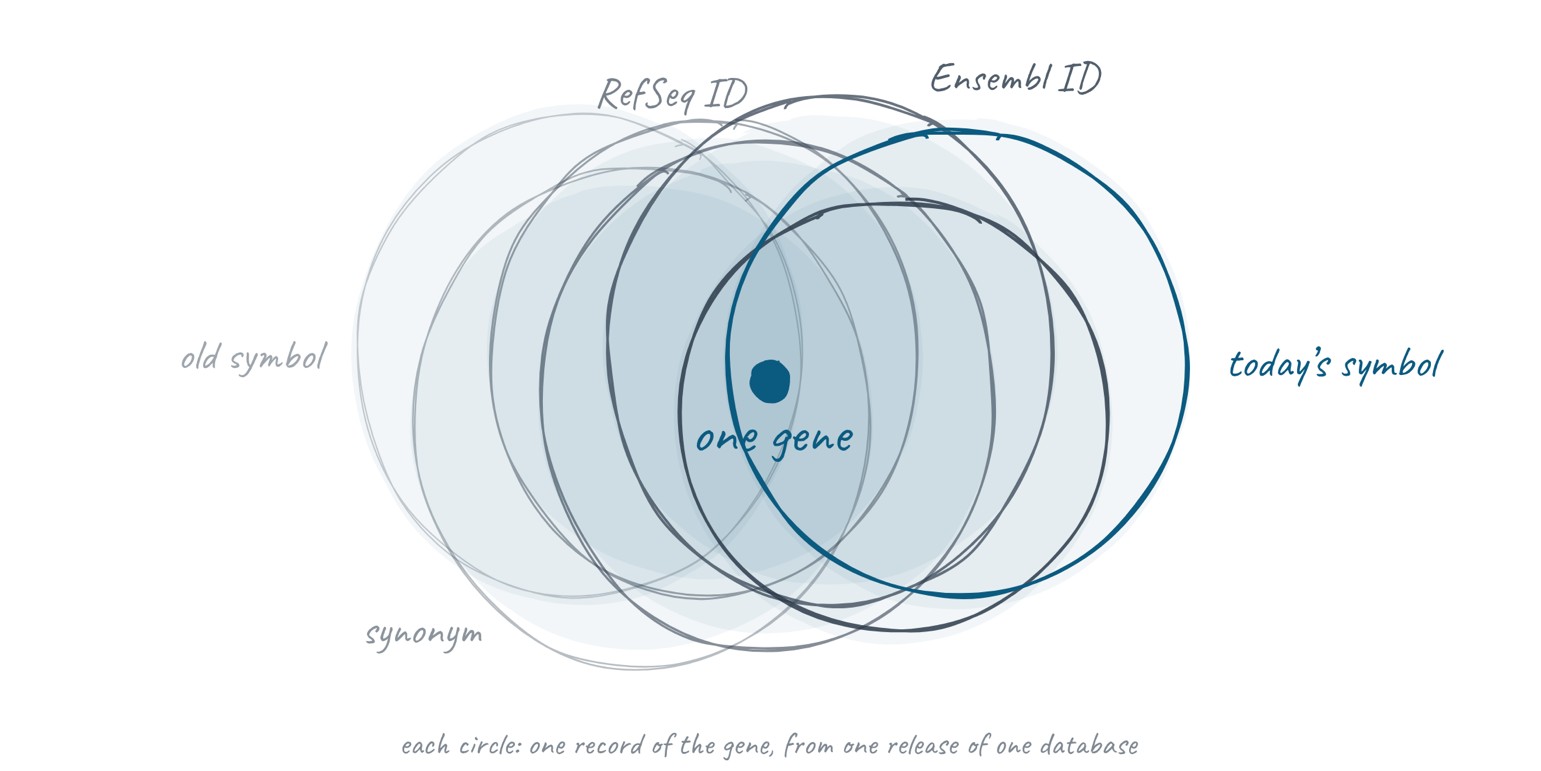
A top-10 biopharmaceutical leader decided to combine years of legacy data with modern data streams, both from its internal laboratories and from outside partners, each labeled its own way. Without a reliable map between old and new, gene data was being left behind or mis-mapped when data sets were merged, preventing comprehensive meta-analysis.
What Semantic Arts did
We modeled the domain, delivering an RDF/OWL solution to separate the concept of a gene or protein from each release-specific record of it, so a gene’s history becomes data that can be queried. Historical and ongoing releases of RefSeq, Ensembl, UniProt, and GENCODE were loaded into the knowledge graph, with each gene record linked to its successors, transcripts, and proteins as well as the cross-species homologs. The result was a dynamic bridge across reference sources with seamless interoperability. The graph includes UniProt’s identifiers and can query UniProt’s public RDF endpoint directly, which allows queries for additional information on cross-species gene homologs. We also aligned to the company’s broader enterprise ontology and its internal in vitro assay and in vivo study graph, so all pertinent data can be queried collectively.
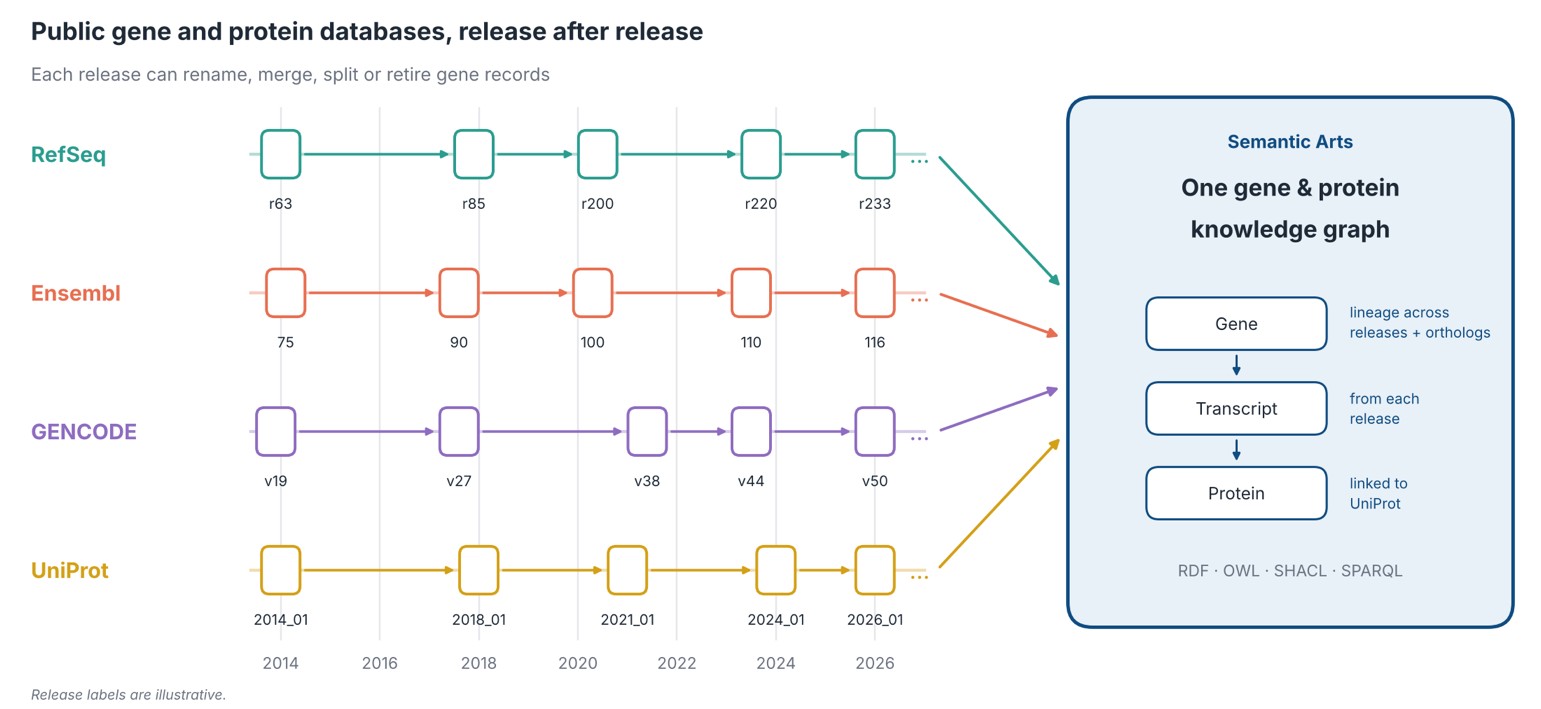
What’s now possible
With the production release of the gene knowledge graph, a scientist can now follow a gene record’s edits as a lineage over time and across curated reference sources. If an old dataset contains a list of gene symbols but lacks bioinformatics metadata, the reference database release it most likely came from can be determined. To increase statistical power, an analyst can now pool samples from CROs and internal labs, labeled with different identifiers, for comprehensive biomarker meta-analyses. Lastly, because our graph links human genes to their counterparts in multiple pertinent animal species, the in vivo team can select animal models most likely to mimic the molecular human disease state for pre-clinical studies.
What’s next
Bring Semantic Arts your most difficult data interoperability challenge in genomics, assay documentation, or pre-clinical designs. We have likely solved something similar. We model your data semantically so you can store it, find it, use it all, scale it, and own it completely. The data’s meaning is self-contained and available for your APIs or LLM interactivity.
All six case studies in one PDF (16 pages, 3.7 MB)
Contact Us
Overcome integration debt with proven semantic solutions. Contact Semantic Arts, the experts in data-centric transformation, today.
Address: Semantic Arts, Inc.
123 N College Avenue Suite 218
Fort Collins, CO 80524
Email: [email protected]
Phone: (970) 490-2224