
How Semantic Arts helped an international crop-protection R&D team build a knowledge graph in which what isn’t a fact is a claim, traced to the analysis and method that produced it.
| Client | Global agricultural-science leader; bioinformatics in crop-protection R&D |
| Domain | Discovery research on crop-protection targets; a close analog of drug-target discovery |
| What we did | Technology choice; ontologies on gist; a claims model with provenance; automated load pipelines |
| Sources | Ortholog analyses, RNA-seq expression data, and public biology (Gene Ontology, FlyBase, UniProt) |
| Standards | RDF and RDF-star (ready for RDF 1.2), OWL, SKOS, SPARQL; gist; public ontology identifiers |
| When | 2026 |
| Status | Proof of concept complete; scaling to about 200 species (Oct 2026) |
The challenge
A global agricultural-science leader develops crop-protection products that must stop the target pest but spare bees, birds, fish, pets, and people. That means joining genome comparisons across dozens of species with gene expression data from internal lab experiments and from public biology. Its pipelines wrote results to unlinked tables, which each scientist analyzed using their own scripts.
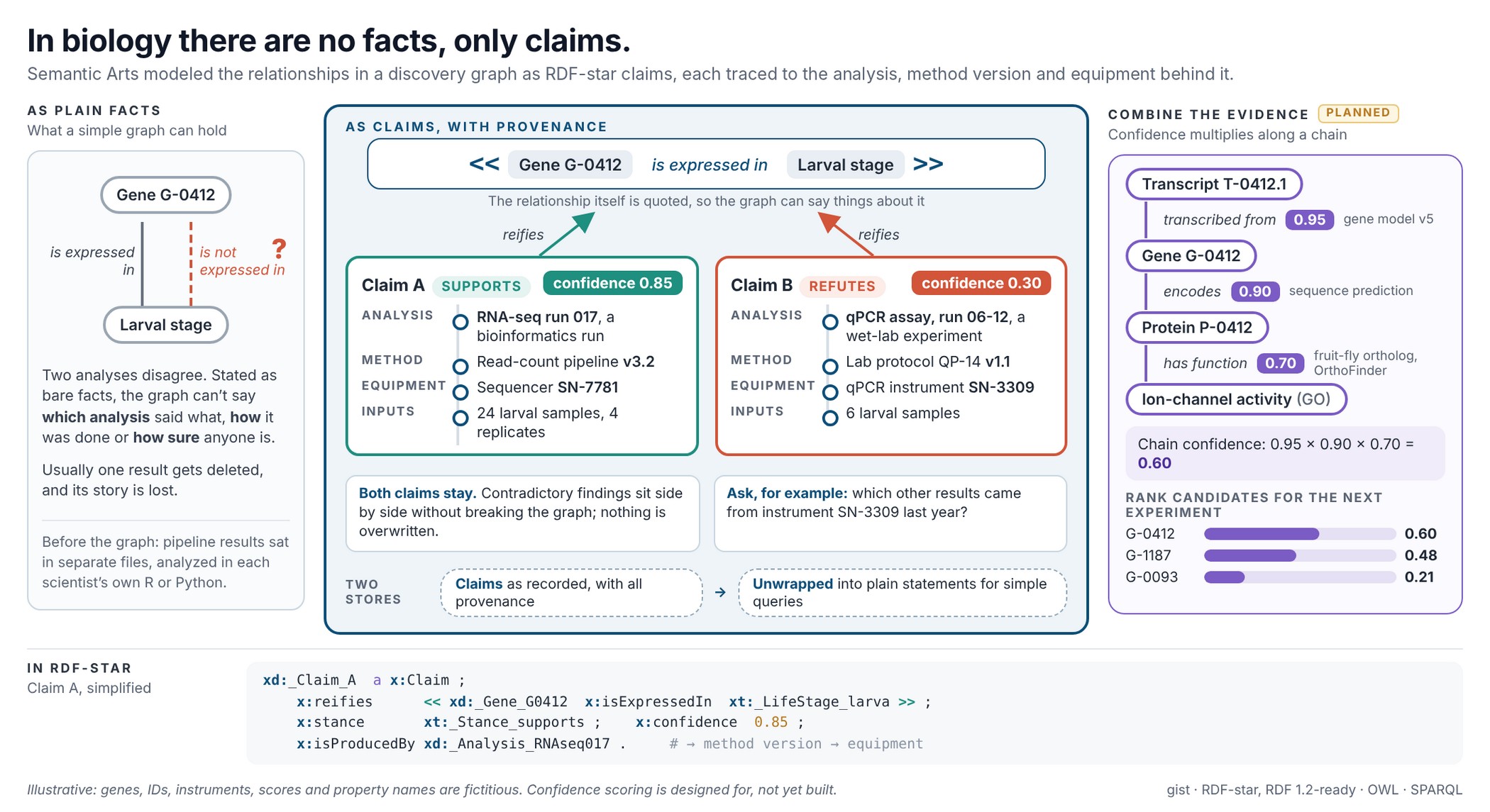
The company’s bioinformatics team started from a principle: in biology there are almost no facts. Two analyses can disagree about the same gene, each for good reasons, and before choosing the next experiment a scientist needs to know what stands behind each result.
What Semantic Arts did
Semantic Arts first helped choose the technology. We laid out the options, and the R&D team chose an RDF knowledge graph, hosted on its own infrastructure, for model expressivity, total data provenance, speed, auditable security, and compatibility with natural-language querying. We then modeled the biology and the science as two models on gist, Semantic Arts’ open upper ontology: one for genes, proteins, pathways, and mode-of-action targets, and one for the scientific process, from hypothesis to experiment, equipment, and finding. Together they are designed to cover all of crop-protection R&D.
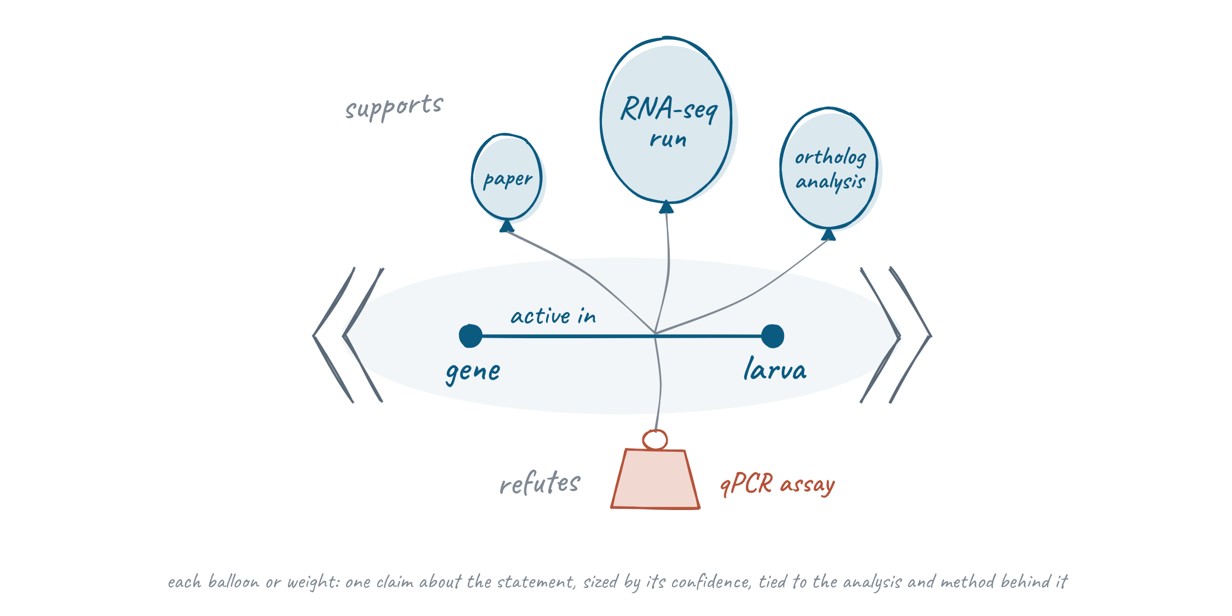
The central design choice was to create relationships as claims. With RDF-star, most relationships are stored as claims that point to the analysis behind them, whether a wet-lab experiment, a published paper, or a bioinformatics run, and to its method and method version. Contradictory findings live side by side, available to drive decision support. Public biology is reused on its own terms: identifiers from Gene Ontology, FlyBase, and NCBI Taxonomy are valued so the data contains connections to these outside sources, while their terms are positioned according to standards within the overarching model. Each source has its own named graph, so an update is a quick reload.
Semantic Arts also automated the loading, with pipelines that turn the outputs of the team’s genome-comparison and expression workflows into graph data with no hand-editing, and proved it with real questions. The proof of concept, about 36 million triples, joined two insect species (one a pest with no public gene annotations) with an expression experiment of about 100 samples. It answered the agreed questions, such as which genes active in pest larvae have well-annotated counterparts in the reference fruit fly genome.
What it makes possible
Scientists can now see every result about a gene or target together with the analysis and method behind it. Conflicting findings stay side by side, so decisions are made with all the evidence in view. And knowledge can be carried from well-studied species to poorly studied pests through gene orthologs, while scientists also check for counterparts in humans and other species that must remain unaffected.
Why it matters in pharma
Drug discovery has the same problem. Target validation weighs assay results, literature, and predictions that often disagree; translational teams move between animal models and human biology; safety teams look for off-target effects through human homologs. A claims graph with provenance keeps all of that evidence in one place, traceable and ready to weigh, rather than flattened into one answer.
What’s next
Semantic Arts is now scaling the graph from 2 species to 200, with a billion triples. The claims are built with the downstream step in focus: a confidence score on each one, combined from transcript to gene to protein to function, so scientists can rank targets for their next experiments.
Your next move
Bring Semantic Arts your most difficult discovery-data challenge, whether it is conflicting assay results, cross-species evidence, or experiment provenance. We have likely solved something similar. We model your data semantically so you can store it, find it, use it all, scale it, and own it completely. The data’s meaning is self-contained and available for your APIs or LLM interactivity.
All six case studies in one PDF (16 pages, 3.7 MB)
Contact Us
Overcome integration debt with proven semantic solutions. Contact Semantic Arts, the experts in data-centric transformation, today.
Address: Semantic Arts, Inc.
123 N College Avenue Suite 218
Fort Collins, CO 80524
Email: [email protected]
Phone: (970) 490-2224