
How Semantic Arts helped the company give research, operations, commercial, and finance data one shared vocabulary, domain by domain.
| Client | Biopharmaceutical leader, 30K+ employees, US$35B+ total revenue |
| Domain | Enterprise data across research, operations, supply chain, commercial, and finance |
| What we did | Ontology design, knowledge graph builds, method workshops, and coaching |
| Standards | OWL, SHACL, SPARQL; FAIR principles |
| When | 2021 to 2023 |
| Status | Completed; follow-on work in regulatory, CMC, and discovery biology |
The challenge
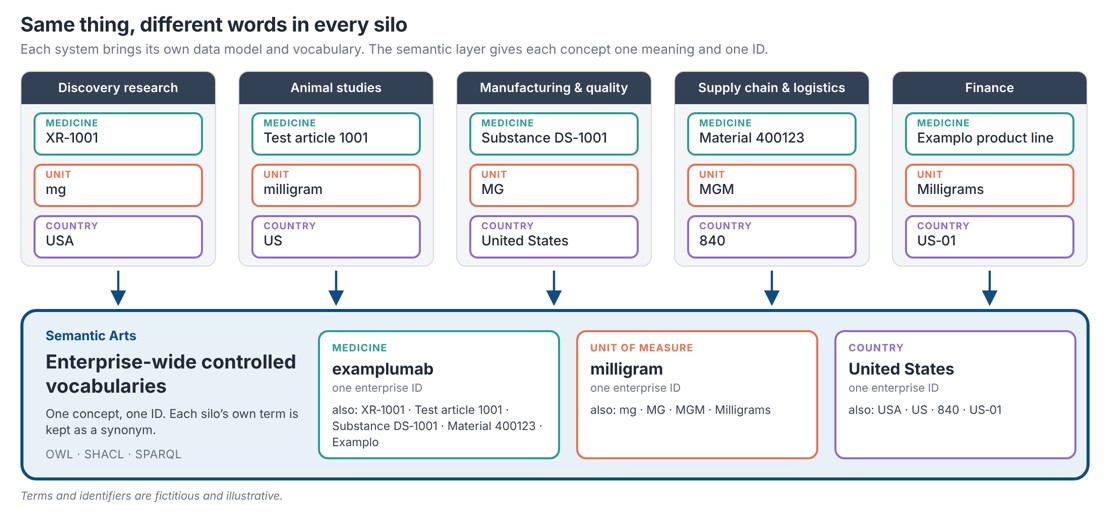
A global biopharmaceutical company drew its data from a multitude of systems, each with its own data model and its own vocabulary. The same thing went by different names in research, manufacturing, supply chain, and finance, so data from one function did not line up with data from another, and each new project made its own copy of the data it needed.
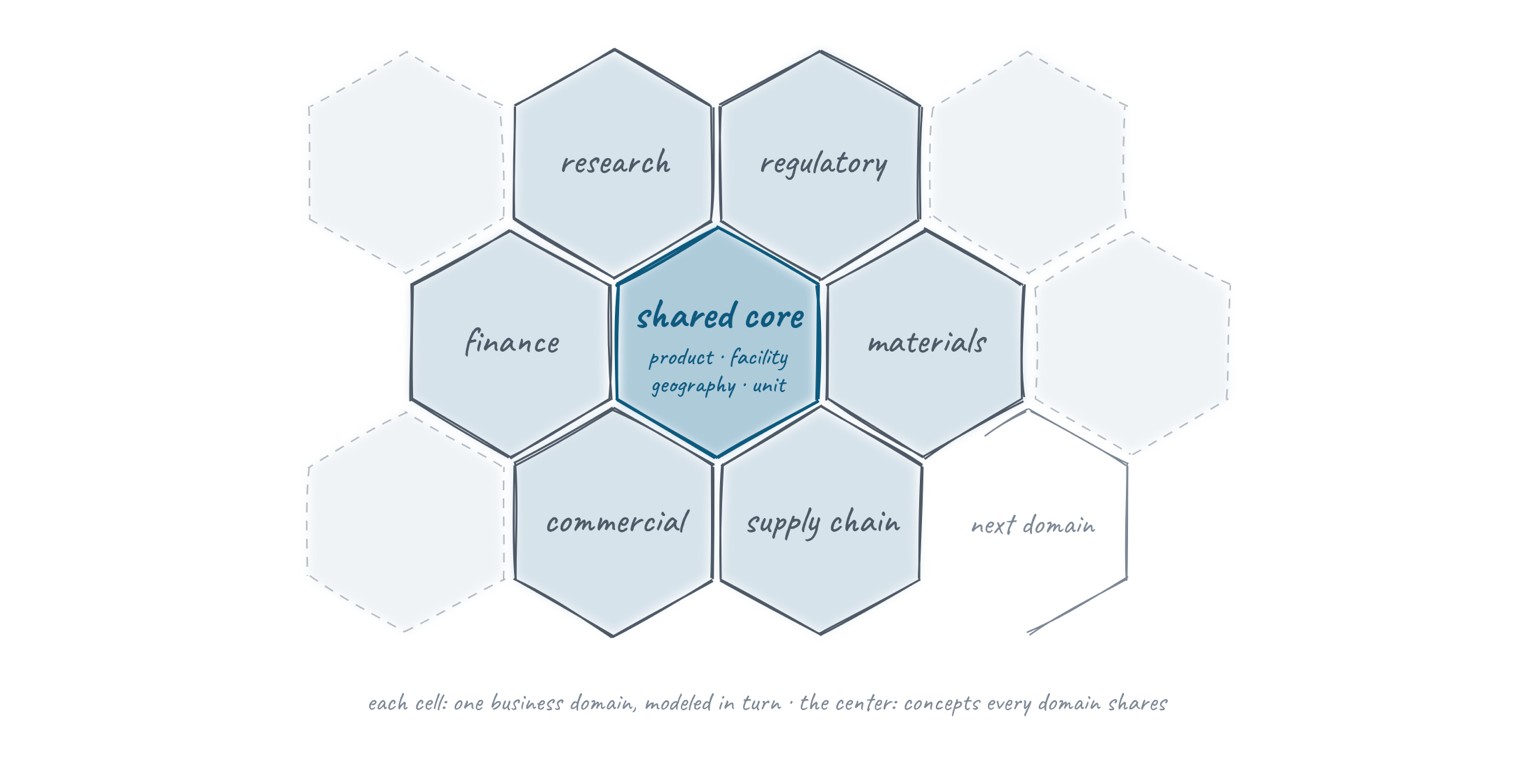
The company’s data leaders agreed that a common language would remove the ambiguities that slow the business. Their answer was a data-centric architecture: a data fabric with a semantic layer, in which data is organized into business domains and represented unambiguously, one model for every system and person. The company had the vision; it needed experienced ontologists to extend the semantic layer, domain by domain.
What Semantic Arts did
We started by blending methods. In joint workshops, the company’s approach to ontology work was combined with ours, and its core ontology was compared with gist, Semantic Arts’ open upper ontology. Each domain then started from the business, not from the systems: the team interviewed subject-matter experts, studied sample data, sketched the concepts, and, with the company’s experts, wrote competency questions, the business questions the graph must answer.
We modeled each domain as an OWL ontology written to the company’s ontology standards, with SHACL shapes to check data loads and guide application builders. Over two years the work spanned research (assays, biologics production, animal studies, research taxonomies, and genomics), regulatory eCMC, materials and sourcing, supply chain, shipping and logistics, commercial and finance, plus the upper-level properties shared across domains. Every model was proved with data: extracts from source systems were mapped to the model, loaded into the knowledge graph, and queried with SPARQL to answer the competency questions. The mappings doubled as specifications for the company’s developers building production loaders. Along the way, we built the company’s own capability with learning sessions for subject-matter experts and coaching to take models into production.
What it makes possible
Research, operations, commercial, and finance data now share one vocabulary in the semantic layer, organized as a map of business domains. The domains connect through shared concepts such as product, facility, geography, and units of measure, so data from different functions fits together. New solutions start from the shared business model instead of a single application, so the same data can serve many applications. And scientific process documentation moves from human-only-readable to human- and machine-readable, ready for analytics and AI.
What’s next
The foundation carried on. Semantic Arts has since worked with the same company on product identification aligned with the IDMP ontology and the Pistoia Alliance, end-to-end regulatory data, CMC, and a gene and protein knowledge graph for discovery biology.
Your next move
Bring Semantic Arts your most difficult enterprise data interoperability challenge, whether it spans research, manufacturing, supply chain, or finance. We have likely solved something similar. We model your data semantically so you can store it, find it, use it all, scale it, and own it completely. The data’s meaning is self-contained and available for your APIs or LLM interactivity.
All six case studies in one PDF (16 pages, 3.7 MB)
Contact Us
Overcome integration debt with proven semantic solutions. Contact Semantic Arts, the experts in data-centric transformation, today.
Address: Semantic Arts, Inc.
123 N College Avenue Suite 218
Fort Collins, CO 80524
Email: [email protected]
Phone: (970) 490-2224