
How Semantic Arts teaches pharma, biotech, and healthcare teams to model, build, and query knowledge graphs themselves, from a two-day leadership workshop to a hands-on course for data engineers.
| Clients | Data-first organizations in the US and Europe from the pharmaceutical, healthcare, supply chain, and financial sectors |
| Domain | R&D, operations, customer delivery |
| What we did | Custom ontology courses, hands-on knowledge-graph training, strategy workshops, coaching on project planning and oversight |
| Formats | Two-day workshops; six-session courses, in person or virtual; modules of Semantic Arts’ ontology design course |
| Standards | RDF, OWL, SHACL, SPARQL; the gist upper ontology; tools such as Protégé, TopBraid EDG, and TARQL |
| When | 2015 to 2026 |
The challenge
Pharmaceutical corporations and other complex organizations are building knowledge graphs across research, manufacturing, regulatory, and clinical data, and they keep running into the same limit: too few people who can model. Most data engineers are strong on tables and SQL, but standards such as RDF, OWL, SPARQL, and semantic tools are new to them. Architects need judgment a TikTok doesn’t give: which upper ontology to start from, how a taxonomy sits beside an ontology, and when a rule belongs in inference rather than in a data-quality check. Leaders want to know where semantics will pay off before they steer the ship toward the future.
Underneath is a simple wish. A company that brings in consultants to build its first models wants its own people to leverage and extend those models, consistently, once the consultants step back.
What Semantic Arts can provide
Semantic Arts shapes each program around who is in the room and what they will build. For instance, for R&D informatics and knowledge-management staff, it ran a bespoke two-day workshop. Day one was a visioning exercise and a map of key capabilities onto the company’s own use cases; day two worked toward an economic-impact model and asked where to start and which capabilities are foundational. Semantic Arts brought in an outside expert for it, a former DARPA program manager for the research that led to OWL.
For a semantic-layer team (its ontologists, data architects, and data engineers), Semantic Arts taught a six-session course: OWL building blocks, properties and classes, the gist upper ontology, taxonomies alongside ontologies, SPARQL, and SHACL. The client shared its own ontology modules and modeling guidelines with the instructors, and during “office hours” they sketched models for questions the team brought, such as clinical-trial milestones and a bill of materials. The course took on the team’s live design questions, including which upper ontology to build on and how an OWL inference differs from a SHACL constraint.
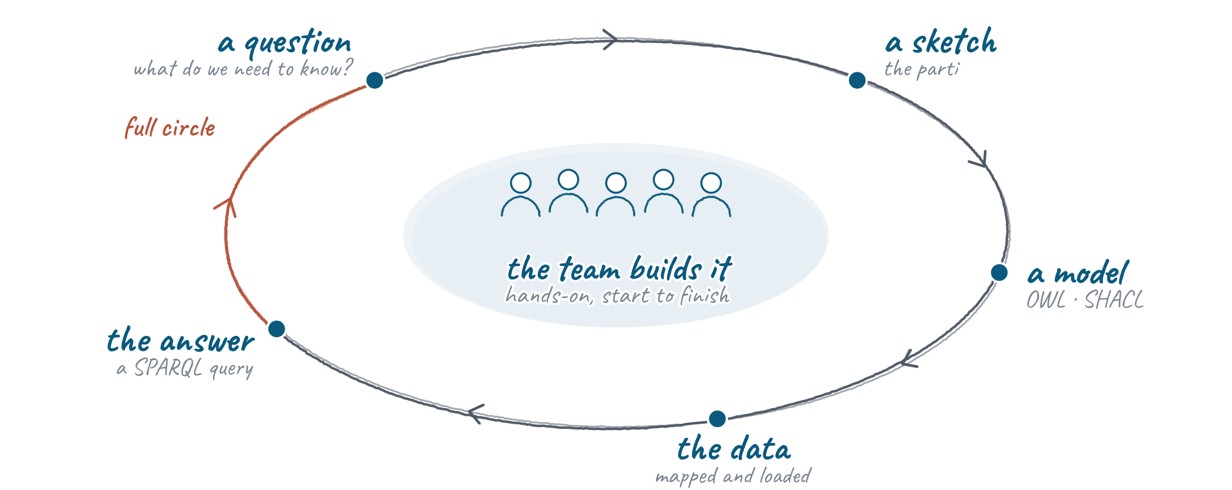
For onboarding data engineers, data scientists, and subject-matter experts to participate in knowledge-graph projects, Semantic Arts ran the full loop shown in Fig 1 in six two-hour sessions, capped at 20 learners so the instructors could offer individualized assistance. Learners queried a public knowledge graph to see what is possible, wrote competency questions, sketched a parti, turned it into an ontology and SHACL shapes, and mapped public COVID-19 data sets to triples with TARQL, minting identifiers and using named graphs so a bad load could be backed out. In the last session they wrote the SPARQL queries that answered the questions they had started with. An engineer from the client’s staff taught one segment and gave a tour of the client’s internal modeling tool.
The same approach, adjusted, has served other clients. A specialty-materials company took a tailored version of Semantic Arts’ ontology design course, with hands-on sessions in the Protégé editor, plus a review of a product taxonomy it had built. A European pharmaceutical company heard Semantic Arts’ shortcut to FAIR data: build a core enterprise ontology, populate it with real data, then catalog data sets against it. Other pharma and healthcare clients have taken customized training and advisory on semantics and knowledge graphs. The instructors are practicing Semantic Arts ontologists, the same people who build client graphs.
What it makes possible
Each program is built so that learners leave having done the work themselves: writing the questions a graph must answer, sketching a model, expressing it in OWL and SHACL, loading data, and proving the result with SPARQL. Modelers and data engineers come away with one vocabulary and one method, so a model can keep growing without its first authors in the room. Leaders get a concrete picture of where semantics fits, what it could be worth, and where to start. And because the instructors also build graphs, teaching continues on the job: at one biopharmaceutical leader, Semantic Arts consultants went on to coach client staff in semantic modeling during later projects.
Why it matters in pharma
Pharma knowledge graphs reach across discovery, CMC, regulatory, and clinical data, and they lean on standards such as BFO, IDMP-O, CDISC, and HL7 FHIR that must be modeled the same way every time. A graph like that keeps its value only if the company’s own people can extend it, and AI assistants that read the graph are only as reliable as its model. Training the team is how a semantic layer outlives the engagement that built it.
What’s next
Semantic Arts tailors each program to the team and its domain, from a leadership workshop to multi-session hands-on courses and coaching, in person or virtually. Training is often paired with a first modeling project, so the team practices on the domain it will build first.
Your next move
Bring Semantic Arts the team you want to grow, whether it is data engineers new to graphs, modelers ready for OWL and SHACL, or leaders deciding where semantics pays off. We will shape the course around your domain, your tools, and your questions. We model your data semantically so you can store it, find it, use it all, scale it, and own it completely.
All six case studies in one PDF (16 pages, 3.7 MB)
Contact Us
Overcome integration debt with proven semantic solutions. Contact Semantic Arts, the experts in data-centric transformation, today.
Address: Semantic Arts, Inc.
123 N College Avenue Suite 218
Fort Collins, CO 80524
Email: [email protected]
Phone: (970) 490-2224